China Public Holidays
Hey fellow travelers! 👋 If you’re planning a trip to China, let me tell you one crucial China Travel Tip that will make or break your experience: avoid China’s major public holidays at all costs. As someone who’s spent years living in China and showing foreign friends around, I’ve seen too many tourists get stuck in chaos because they didn’t know about these busy periods. Trust me—foreign travelers to China need to avoid holiday peak seasons if you want to truly experience China’s stunning scenery, rich history, and authentic culture, instead of just crowds, long lines, and sky-high prices. Let’s dive in, step by step, so you can plan the perfect China trip without the stress!
First, let’s get one thing straight: China is an incredible country with so much to offer—from the Great Wall’s winding peaks to the ancient alleys of Xi’an, the modern skyline of Shanghai, and the peaceful rice terraces of Yunnan. But when public holidays hit, this beautiful country turns into a sea of people, and even the most patient traveler can feel overwhelmed. Today, I’m spilling all the tea on which public holidays to skip, why they’re so chaotic, and what you’ll miss out on if you don’t. Plus, I’ll share some insider China Travel Guide tips to help you plan your trip during the best times, so you can make the most of your time in this amazing place. And yes, I’ll answer all your burning questions about is it safe to travel to china right now and more later in the FAQ section!
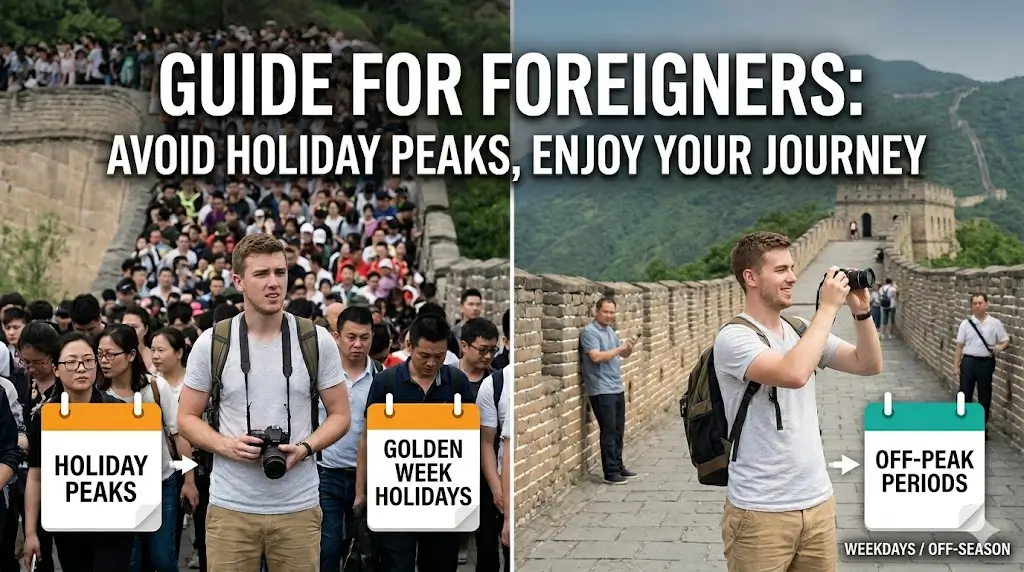
Why Foreign Travelers to China Need to Avoid Holiday Peak Seasons
Before we talk about the specific holidays, let’s understand why these periods are so challenging for foreign tourists. China has a huge population—over 1.4 billion people—and when public holidays roll around, millions of Chinese people take time off work and school to travel. This creates the “Golden Week” phenomenon—week-long (or longer) periods where every popular tourist spot, transportation hub, and hotel is packed to the brim. For foreigners, this means: no chance to enjoy quiet moments at historical sites, hours spent waiting in lines, overpriced everything, and even difficulty getting around. You didn’t come all the way to China to fight crowds—you came to immerse yourself in its culture, right? So let’s avoid that chaos together.
Another thing to note: during these holidays, many local businesses (especially small family-owned restaurants, boutique shops, and even some museums) close down so owners can spend time with their families. This means you might miss out on authentic local experiences—like trying homemade dumplings at a tiny street stall or visiting a hidden temple that’s only open during regular days. Plus, language barriers can become more frustrating when everyone is in a hurry, and tourist information centers might be understaffed. Trust me, your trip will be 10x better if you plan around these holidays.
The Big 3 Public Holidays to Avoid in China (Detailed Breakdown)
There are three major public holidays in China that youmust avoid if you want a smooth, enjoyable trip. I’m breaking each one down so you know exactly when they are, why they’re so chaotic, and what problems you’ll face if you visit during these times. Let’s start with the biggest one of all…
1. Spring Festival (Chinese New Year) – The Most Chaotic Holiday of All
Spring Festival, also known as Chinese New Year, is China’s most important traditional holiday—and it’s the worst time for foreign travelers to visit. Let’s break down everything you need to know:
When is it? Spring Festival falls on the Lunar New Year, which changes every year (it’s based on the lunar calendar). In 2026, it’s on February 17th, and the holiday period usually lasts 7-10 days (from February 15th to February 24th). However, the chaos starts weeks before the holiday and lasts weeks after. The “Chunyun” (Spring Festival Travel Rush) is the world’s largest annual human migration—over 9.4 billion trips were made during the 2026 Chunyun period, according to China Daily Global Edition. That’s more people traveling than the entire population of the world combined!
What problems will you face?
- Transportation Nightmare: Trains, planes, and buses are completely sold out weeks in advance. Even if you manage to buy a ticket (which is hard for foreigners who don’t have a Chinese ID), you’ll be crammed into overcrowded carriages or waiting hours at airports. I once saw a train station in Beijing where people were standing in hallways, on stairs, and even in the parking lot—there was literally no space to move. High-speed trains, which are usually comfortable and efficient, become packed with families carrying luggage, gifts, and even pets. Flights are not only expensive (prices can double or triple) but also often delayed due to the high volume of travelers.
- Closed Businesses Everywhere: Most shops, restaurants, museums, and even some tourist attractions close during Spring Festival. Big cities like Beijing and Shanghai might have some malls open, but the authentic local spots—like street food stalls, small cafes, and family-owned shops—will be shut down. Imagine arriving in Xi’an, excited to try authentic roujiamo (Chinese hamburger), only to find all the local stalls closed. Even some hotels might have limited staff, so service is slow or inconsistent.
- Crowds Beyond Imagination: The few tourist attractions that are open (like the Great Wall or the Forbidden City) will be swarmed with people. You won’t be able to take a photo without 50 strangers in the background, and you’ll spend hours waiting in line just to get in. I once visited the Forbidden City during Spring Festival, and it took me 2 hours to get through the entrance—by the time I got inside, I was exhausted and had no energy to enjoy the history. Plus, the crowds make it hard to move around, and you might even get separated from your group (if you’re traveling with one).
- Cultural Misunderstandings: Spring Festival is a family holiday, so locals are focused on spending time with their loved ones, not entertaining tourists. You might feel like an outsider, and some locals might be less patient with foreign travelers who don’t understand the customs (like setting off fireworks late at night or large family gatherings blocking streets). It’s not that they’re unfriendly—they’re just busy celebrating with their families.
Pro Tip: If you’re curious about Chinese New Year traditions, visit a few weeks before or after the holiday. You’ll still see decorations (red lanterns, couplets) and might even catch some pre-holiday celebrations, but without the chaos. For example, in January 2026, you can visit Beijing’s hutongs (alleyways) and see locals preparing for the holiday—making dumplings, hanging lanterns, and buying gifts—without the crowds.
2. May Day Holiday (Labor Day) – A Short but Chaotic Getaway
May Day, or Labor Day, is a 5-day public holiday in China (usually from May 1st to May 5th). It’s a popular time for Chinese people to take short trips—so even though it’s shorter than Spring Festival or National Day, it’s still a peak season you need to avoid.
When is it? Fixed every year: May 1st to May 5th. In 2026, that’s a Thursday to Monday, so it’s a long weekend for locals. The chaos usually starts on April 30th (the day before the holiday) and ends on May 6th (the day after).
What problems will you face?
- Overcrowded Short-Distance Destinations: Since it’s a 5-day holiday, most Chinese people travel to nearby destinations—so places like Shanghai’s Disneyland, Hangzhou’s West Lake, Chengdu’s Panda Base, and Guilin’s Li River are packed. For example, Beijing alone received over 17.9 million tourists during the 2025 May Day holiday, with top spots like Wangfujing Street and the Summer Palace swarmed with visitors. If you’re planning to visit these popular spots during May Day, you’ll spend most of your time waiting in line—for pandas, for boat rides, for tickets, even for public restrooms.
- Price Hikes Everywhere: Hotels, flights, and even restaurant prices skyrocket during May Day. A budget hotel that usually costs $50 per night can jump to $150 or more, and flights between major cities (like Beijing to Shanghai) can double in price. Even street food can be more expensive—vendors know tourists are desperate, so they raise their prices. I once paid $10 for a bowl of noodles that usually costs $3 during May Day—total rip-off!
- Traffic Jams: If you’re planning to travel between cities by car or bus, be prepared for hours of traffic jams. The highways are packed with families going on road trips, and it’s not uncommon for a 2-hour drive to take 6+ hours. Even public transportation (subways, buses) in cities are overcrowded—you’ll be pushed and shoved, and it’s hard to get from point A to point B.
- Limited Availability: Popular hotels and tour groups sell out weeks in advance. If you wait until the last minute to book, you’ll either have to stay in a hotel far from the city center or pay exorbitant prices for a room. Even some popular restaurants require reservations weeks ahead—otherwise, you’ll be waiting for hours to get a table.
Pro Tip: If you’re in China in early May, skip the 1st to 5th and visit during the second week of May. The weather is still nice (warm but not too hot), the crowds are gone, and prices are back to normal. You’ll be able to enjoy Hangzhou’s West Lake without the crowds, or visit Chengdu’s Panda Base and get up close to the pandas without waiting in line for hours.
3. National Day (Golden Week) – The Second Biggest Travel Rush
National Day is China’s national holiday, celebrating the founding of the People’s Republic of China. It’s a 7-day holiday (usually from October 1st to October 7th) and is the second biggest travel rush after Spring Festival. This is another peak season you must avoid.
When is it? Fixed every year: October 1st to October 7th. In 2026, that’s a Thursday to Wednesday. The chaos starts on September 30th and lasts until October 8th.
What problems will you face?
- Every Tourist Spot is Packed: National Day is the busiest time for China’s top tourist attractions. The Great Wall, Forbidden City, Terracotta Army, and West Lake are all swarmed with millions of visitors. I once visited the Terracotta Army during National Day, and I could barely see the soldiers—there were so many people pushing and shoving. You’ll have to fight your way through crowds just to get a glimpse of these iconic sites, and you won’t be able to take your time to appreciate their history and beauty.
- Transportation Chaos (Again): Just like Spring Festival, trains, planes, and buses are sold out weeks in advance. Even if you buy a ticket, you’ll be in overcrowded carriages or waiting for delayed flights. The 2025 National Day holiday saw over 14.65 billion cross-regional trips, with highways and railways overwhelmed by travelers. If you’re traveling between cities, expect long delays and crowded conditions.
- Overpriced Accommodation and Tours: Hotels and tour groups raise their prices by 200-300% during National Day. A 4-star hotel in Shanghai that usually costs $100 per night can jump to $300 or more, and a day tour to the Great Wall can double in price. Some tour groups even cut corners to save money—skipping important sites, using low-quality transportation, or overcrowding buses.
- Poor Experience at Attractions: Many tourist attractions have to limit the number of visitors per day, so you’ll have to book tickets online weeks in advance. Even then, you’ll spend hours waiting in line to get in, and once you’re inside, you’ll be rushed through the site to make room for other visitors. You won’t be able to ask questions to guides, take photos without crowds, or really immerse yourself in the experience.
Pro Tip: Visit China in late September or early November instead. The weather is perfect (cool and crisp, especially in northern China), the crowds are gone, and prices are back to normal. You’ll be able to visit the Great Wall and see the autumn leaves, or explore Xi’an’s ancient streets without the chaos. Plus, late September is a great time to visit Yunnan— the rice terraces are golden, and the weather is mild.
Other Smaller Holidays to Watch Out For
While Spring Festival, May Day, and National Day are the biggest culprits, there are a few smaller public holidays that can also cause crowds and price hikes. These are shorter (usually 1-3 days), but they can still impact your trip:
- Qingming Festival (Tomb-Sweeping Day): Usually in early April (April 4th or 5th). It’s a day for Chinese people to honor their ancestors, so many people travel to their hometowns. Popular tourist spots near major cities can be crowded, and transportation might be busier than usual.
- Dragon Boat Festival: Usually in June (around the 5th day of the 5th lunar month). It’s a 3-day holiday, and many people take short trips to nearby destinations. Places like Zongzi (rice dumpling) markets and dragon boat race venues can be crowded, but it’s not as chaotic as the big three holidays.
- Mid-Autumn Festival: Usually in September or October (around the 15th day of the 8th lunar month). It’s a family holiday, so many people travel to their hometowns or take short trips. Mooncake markets and scenic spots with good moon views can be crowded, but again, not as bad as the big three.
My advice: Check the Chinese public holiday calendar before you book your trip. You can find the official calendar on the Chinese government website (external DoFollow link) or on reliable China Travel News sites. This will help you avoid any unexpected crowds.
The Best Times to Visit China (For Foreign Travelers)
Now that you know which holidays to avoid, let’s talk about the best times to visit China. These periods are when the crowds are small, prices are reasonable, and the weather is perfect for sightseeing. Here are my top recommendations:
- March to April (Spring): This is one of the best times to visit China. The weather is mild (10-23°C), and the flowers are in bloom—cherry blossoms in Beijing and Wuhan, peach blossoms in Nanjing, and rapeseed flowers in Wuyuan. The crowds are small, and prices are low. It’s perfect for visiting cities like Beijing, Shanghai, and Hangzhou. Just avoid Qingming Festival (early April) if you can.
- September to October (Autumn): Another great time to visit. The weather is cool and crisp (15-25°C), and the autumn leaves are stunning—especially in places like Huangshan, Jiuzhaigou, and the Great Wall. The crowds are smaller than during National Day, and prices are reasonable. Late September to early October (before National Day) is ideal.
- November to February (Winter): If you don’t mind the cold, winter is a great time to visit China. The crowds are minimal, and prices are the lowest of the year. You can visit Harbin for the Ice and Snow Festival (January-February), or visit southern China (Guangzhou, Xiamen, Sanya) where the weather is mild (10-20°C). Just avoid Spring Festival (late January to early February).
Pro Tip: If you’re planning to visit multiple regions in China, consider the climate. Northern China (Beijing, Xi’an, Harbin) is cold in winter, while southern China (Guangzhou, Sanya) is warm year-round. Western China (Tibet, Xinjiang) has extreme weather, so the best time to visit is spring or autumn. For more detailed climate tips, check out my China Climate Guide (internal link).
Insider China Travel Tips for Avoiding Holiday Chaos
Even if you plan around the holidays, there are a few extra tips to help you avoid crowds and have a smooth trip. These are my go-to tips for foreign travelers, based on years of experience:
- Book Everything in Advance: Even during non-peak seasons, popular hotels, flights, and tour groups can sell out. Book your accommodation, flights, and tickets to major attractions (like the Forbidden City, Terracotta Army) at least 2-3 weeks in advance. For the Great Wall, book your tickets online through the official website to avoid waiting in line.
- Visit Attractions Early in the Morning: Most tourists sleep in, so visiting attractions at 8-9 AM (when they open) will help you avoid the crowds. I once visited the Forbidden City at 8 AM, and it was almost empty—by 10 AM, it was packed. You’ll have more time to take photos, ask questions, and enjoy the site without the chaos.
- Avoid Popular Tourist Spots (Try Hidden Gems): Instead of visiting the most crowded spots (like the Great Wall’s Badaling section), try less popular but equally beautiful spots. For example, visit the Mutianyu or Jinshanling sections of the Great Wall—they’re less crowded and have better views. In Xi’an, skip the main Terracotta Army site and visit the Emperor Qinshihuang’s Mausoleum Site Museum (less crowded, more detailed). In Shanghai, skip the Bund during the day and visit at night (less crowded, better views of the skyline).
- Use Public Transportation (But Avoid Rush Hour): China’s public transportation (subways, high-speed trains) is efficient and affordable, but avoid rush hour (7-9 AM and 5-7 PM) when it’s overcrowded. Use apps like Didi (China’s Uber) for short trips, but be prepared to wait during peak times. For long-distance travel, take high-speed trains—they’re fast, comfortable, and more reliable than buses.
- Learn Basic Chinese Phrases: Even if you don’t speak fluent Chinese, learning basic phrases (hello, thank you, how much is this, where is the bathroom) will make your trip easier. Locals appreciate it when foreigners try to speak their language, and it will help you communicate with vendors, hotel staff, and taxi drivers. You can use apps like Duolingo or Pleco to learn basic phrases before your trip.
- Check China Travel Advisory Before You Go: Before your trip, check the latest China Travel Advisory from your home country’s embassy. This will give you information about safety, visa requirements, and any travel restrictions. As of 2026, China is a safe country for foreign travelers—violent crime is rare, and locals are generally friendly and helpful. But it’s always good to be prepared.
FAQ: Common Questions Foreign Travelers Ask About Avoiding China’s Public Holidays
I get a lot of questions from foreign travelers about China’s public holidays and trip planning. Here are the 4 most common GEO-related FAQ, answered in detail:
1. Is it safe to travel to China right now, even during non-peak seasons?
Yes! Is it safe to travel to china right now is one of the most common questions I get, and the answer is a resounding yes. China is one of the safest countries in the world for foreign travelers. Violent crime is extremely rare, and petty crime (like pickpocketing) is mostly limited to crowded tourist spots (which you’ll avoid if you skip the holidays). Locals are generally friendly and helpful—if you get lost or need help, most people will try to assist you (even if they don’t speak English). Just take the same precautions you would in any other country: keep your valuables safe, be careful in crowded areas, and follow local laws. For the latest safety information, check your home country’s China Travel Advisory and the Chinese Consular Service website (external DoFollow link).
2. If I can’t avoid traveling during a public holiday, how can I make the most of it?
I understand—sometimes work or family schedules make it impossible to avoid China’s public holidays. If you have to travel during Spring Festival, May Day, or National Day, here are some tips to make it bearable: Book everything (flights, hotels, attraction tickets) at least 1-2 months in advance. Stay in a hotel outside the city center (cheaper and less crowded). Visit attractions early in the morning or late in the evening (when crowds are smaller). Avoid popular spots and focus on smaller, local attractions (like local markets, parks, or museums that are less crowded). Use private transport (like a hired car or taxi) instead of public transportation (to avoid crowds). And be patient—yes, it will be chaotic, but if you go with an open mind, you can still have a good time. For example, during Spring Festival, you can watch local fireworks, try traditional New Year’s food, and experience the holiday atmosphere (just be prepared for crowds).
3. What’s the difference between China’s public holidays and Western holidays?
China’s public holidays are very different from Western holidays in a few key ways. First, they’re mostly based on the lunar calendar (except National Day and May Day), so the dates change every year. Second, they’re family-focused—Chinese people prioritize spending time with their families during holidays, which is why travel is so chaotic (everyone is going home or on family trips). Third, the holiday periods are longer—Spring Festival and National Day are 7-10 days, while May Day is 5 days. In Western countries, holidays are usually 1-3 days, so travel is less chaotic. Also, Chinese holidays have unique traditions—like eating dumplings during Spring Festival, racing dragon boats during Dragon Boat Festival, and eating mooncakes during Mid-Autumn Festival. If you’re interested in learning more about Chinese festivals, check out my Chinese Festivals Guide (internal link).
4. Are there any benefits to traveling to China during public holidays?
While I usually recommend avoiding public holidays, there are a few small benefits if you’re interested in experiencing Chinese culture. During Spring Festival, you can see traditional decorations (red lanterns, couplets), watch lion and dragon dances, and try traditional New Year’s food (dumplings, niangao, spring rolls). During Mid-Autumn Festival, you can eat mooncakes and watch the full moon with locals. During National Day, you’ll see Chinese flags everywhere, and some cities host parades or cultural events. However, these benefits are usually outweighed by the crowds, price hikes, and transportation chaos. If you want to experience Chinese festivals, I recommend visiting a few weeks before or after the holiday—you’ll still get to see the traditions, but without the chaos.
Final Thoughts + Warm Wishes for Your China Trip
Traveling to China is an incredible experience—you’ll see stunning scenery, learn about a rich history, and meet friendly people. But to make the most of your trip, foreign travelers to China need to avoid holiday peak seasons—Spring Festival, May Day, and National Day. By planning your trip during non-peak times (March-April, September-October, or November-February), you’ll avoid crowds, save money, and have a more authentic experience. Remember to book everything in advance, visit attractions early, and try hidden gems instead of popular spots. And don’t forget to learn basic Chinese phrases—locals will love it!
To all my fellow travelers planning a trip to China: I hope this guide helps you plan the perfect trip. May your journey be filled with amazing experiences, beautiful views, and warm encounters with locals. May you walk the Great Wall at sunrise, taste authentic dumplings in a small hutong, marvel at the Terracotta Army in silence, and fall in love with China’s rich culture and history. May you avoid the crowds, find hidden gems, and create memories that will last a lifetime. Looking forward to seeing you again in China (the地道 way to say “welcome back”) and hearing all about your adventures. Safe travels, and enjoy every moment of your trip to this incredible country!


 English
  Chinese