China Visa-Free
As a full-time China travel blogger who’s spent 8 years helping foreign travelers unlock the magic of China—from the Great Wall’s winding peaks to Shanghai’s glittering skyline, and the ancient alleyways of Xi’an to the tropical beaches of Hainan—I get the same question every single day: “Do I need a visa to travel to China in 2026?”
If you’re dreaming of your perfect China trip but stressing over endless visa paperwork, confusing rules, and long application wait times, you’re in the right place. This 2026 China Visa-Free Policy for Foreign Tourists guide breaks down every single detail you need to know: which countries qualify for visa-free entry, step-by-step entry processes, hidden rules you can’t afford to miss, and game-changing China Travel Tips to make your trip completely seamless. No stuffy government jargon, no hidden fine print, no outdated information—just honest, up-to-date guidance straight from official sources including the official Chinese Visa Centre website (https://www.visaforchina.cn) and the National Immigration Administration of China (https://s.nia.gov.cn).
Whether you’re planning a 2-week backpacking trip across China, a quick layover adventure in a major city, a luxury family beach holiday in Hainan, or a deep dive into China’s 5,000 years of history and culture, this guide will tell you exactly if you can skip the Chinese Visa Application process entirely. I’ll also walk you through exactly what to do if you don’t qualify for visa-free entry, so you can plan your trip with total confidence. This is the only China Travel Guide you’ll need to navigate China’s visa rules in 2026.
What Is China’s Visa-Free Policy & Who Can Benefit in 2026?
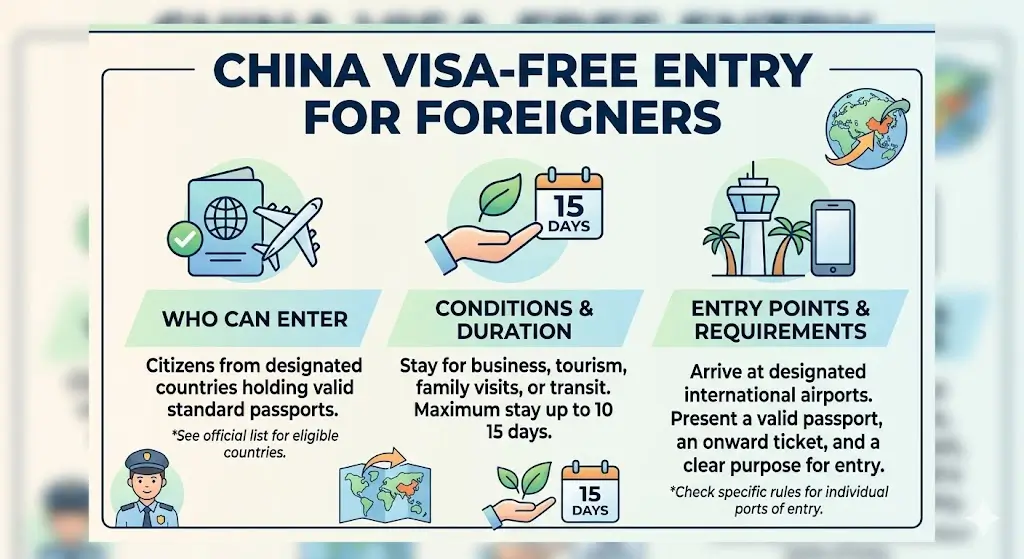
China’s visa-free policy is a set of official rules that allow foreign nationals from eligible countries to enter China without applying for a traditional visa in advance, for a set period of time, for approved purposes including tourism, family visits, and short-term business. In 2026, these policies fall into four core categories, each with different eligibility rules, stay limits, and travel permissions. I’ve broken each one down in simple, easy-to-follow terms, with a focus on the world’s most mainstream travel nationalities listed on the official Chinese Visa Centre platform.
1. Full Mutual Visa Exemption: No Visa Needed for Nationwide China Travel
This is the most flexible and hassle-free visa-free option, as it allows you to enter any port of entry in China, travel anywhere across the country, and stay for a set period without any transit requirements. These rules come from official mutual visa exemption agreements between China and your home country, meaning Chinese citizens also get the same visa-free benefits when visiting your country.
Eligible Nationalities & Stay Limits (2026 Update)
- 90-Day Visa-Free Stay: Armenia, Barbados, Bahamas, Belarus, Bosnia and Herzegovina, Ecuador, Fiji, Grenada, Mauritius, San Marino, Seychelles, Serbia, Suriname, Tonga
- 30-Day Visa-Free Stay: United Arab Emirates (UAE), Qatar, Singapore, Brunei, Japan, Thailand, Kazakhstan, Mongolia, Georgia, Maldives
- 15-Day Visa-Free Stay: Ireland
All nationalities listed above can enter China via any international port of entry, travel freely across all provinces and regions of China, and stay for the full allowed period for tourism, family visits, or short-term business, with no need to apply for a visa in advance.
Core Eligibility Rules
- You must hold a valid ordinary passport (diplomatic, service, and official passports have separate rules not covered in this travel guide)
- Your passport must have a minimum validity of 6 months from the date you plan to leave China
- Your passport must have at least 2 blank visa pages for entry and exit stamps
- You must have proof of a return or onward flight ticket, and proof of accommodation for your stay in China (border officials may conduct random checks)
- You must not have any previous immigration violations in China, and must not be on any entry blacklist
2. 144-Hour Visa-Free Transit: The Most Popular Option for Short China Trips
If your home country isn’t on the full mutual visa exemption list, this is the most widely used visa-free option for foreign tourists visiting China. The 144-hour (6 full days) visa-free transit policy allows eligible foreign nationals to enter China without a visa, as long as they are transiting through China to a third country or region. This policy covers the vast majority of mainstream travel nationalities from Europe, North America, Oceania, and Asia, including most countries listed on the official Chinese Visa Centre website.
Eligible Nationalities (Mainstream Travel Countries)
Australia, Austria, Belgium, Canada, Czechia, Denmark, Finland, France, Germany, Greece, Hungary, Iceland, Ireland, Italy, Japan, Republic of Korea (ROK), Malaysia, Netherlands, New Zealand, Norway, Poland, Portugal, Russia, Singapore, Spain, Sweden, Switzerland, Thailand, United Kingdom (UK), United States of America (USA), United Arab Emirates (UAE)
Non-Negotiable Eligibility Rules (Critical to Avoid Entry Refusal)
- Mandatory Third-Country/Region Transit Rule: Your travel itinerary must follow the structure: Departure Country/Region → China Port of Entry → Third Country/Region. This means you cannot enter and exit China to/from the same country/region. For example:
- ✅ Eligible: USA → Shanghai → Japan | UK → Beijing → Hong Kong, China | Australia → Guangzhou → Singapore
- ❌ Not Eligible: USA → Shanghai → USA | UK → Beijing → UK | Australia → Guangzhou → Australia
- Key Note: Hong Kong, China and Macao, China are classified as separate “regions” for transit purposes, so traveling from your home country to Hong Kong, then to mainland China, then back to your home country counts as a valid transit itinerary.
- Confirmed Onward Travel Ticket: You must hold a confirmed, pre-booked flight, train, or ship ticket with a fixed seat and date, departing China within 144 hours of your arrival, to your third country/region. The ticket must depart from the same port cluster you entered through.
- Valid Travel Documents: Your passport must have at least 6 months of validity remaining, with 2 blank visa pages.
- Approved Port of Entry: You must enter and exit through one of China’s approved 144-hour transit visa-free ports. The most popular ports for tourists include:
- Beijing Capital International Airport & Beijing Daxing International Airport (allowed travel area: Beijing, Tianjin, Hebei Province)
- Shanghai Pudong International Airport & Shanghai Hongqiao International Airport (allowed travel area: Shanghai, Jiangsu Province, Zhejiang Province)
- Guangzhou Baiyun International Airport & Shenzhen Bao’an International Airport (allowed travel area: Guangdong Province)
- Chengdu Tianfu International Airport, Hangzhou Xiaoshan International Airport, Xi’an Xianyang International Airport, Chongqing Jiangbei International Airport
3. 72-Hour Visa-Free Transit: For Smaller Regional Port Entry
For travelers visiting smaller, less tourist-dense cities in China, the 72-hour (3 full days) visa-free transit policy applies to 23 additional regional ports across China, including Guilin, Kunming, Xiamen, Dalian, and Qingdao. The eligibility rules are identical to the 144-hour policy, with the only differences being:
- A maximum stay of 72 hours from your arrival time
- You are only allowed to travel within the single province/municipality of your port of entry
- This policy covers the same eligible nationalities as the 144-hour transit scheme
4. Regional Visa-Free Policies: For Destination-Specific China Travel
China also offers destination-specific visa-free policies for tourists visiting popular travel regions, the most widely used being the Hainan 59-Country Visa-Free Policy, designed exclusively for tourists visiting China’s tropical island province.
Hainan 59-Country Visa-Free Policy (30-Day Stay)
This policy allows foreign nationals from 59 eligible countries to enter Hainan Province directly, without a visa, for a maximum stay of 30 days, with no transit requirements. This is the perfect option for travelers planning a dedicated beach holiday, golf trip, or tropical adventure in Hainan, without needing to travel to other parts of mainland China.
Eligible Mainstream Nationalities
Australia, Austria, Belgium, Canada, Denmark, Finland, France, Germany, Greece, Ireland, Italy, Japan, Republic of Korea (ROK), Malaysia, Netherlands, New Zealand, Norway, Poland, Portugal, Russia, Singapore, Spain, Sweden, Switzerland, Thailand, United Kingdom (UK), United States of America (USA), United Arab Emirates (UAE)
Core Rules
- You can only enter and exit Hainan via Haikou Meilan International Airport or Sanya Phoenix International Airport
- You are only allowed to travel within Hainan Province during your 30-day stay; travel to other parts of mainland China is strictly prohibited
- You must hold a valid passport with 6 months of validity remaining, a confirmed return/onward flight ticket departing Hainan within 30 days, and proof of pre-booked accommodation in Hainan
- As of 2023, individual travelers can enter directly without pre-registration through a travel agency, making this policy more accessible than ever
Step-by-Step Visa-Free Entry Process to China in 2026
One of the biggest fears I hear from travelers is “I don’t know what to do at the border, and I’m scared I’ll be refused entry”. Below, I’ve broken down the exact, step-by-step entry process for each visa-free category, in the order you’ll experience it, so you can walk through the border with total confidence.
Step-by-Step Entry Process for Full Mutual Visa Exemption
This is the simplest entry process, with minimal steps required:
- Prepare Your Documents Before Departure: Before your flight, double-check that you have your valid passport (6+ months validity, 2 blank pages), a printed or digital copy of your return/onward flight ticket, and proof of your hotel/accommodation bookings for your stay in China. I always recommend printing physical copies, as some border checkpoints have limited digital scanning capabilities.
- Complete Your In-Flight Entry Card: On your international flight to China, the cabin crew will hand out a Foreigner Entry Card. Fill this out completely with your personal information, passport number, intended stay address in China, contact information, and travel purpose. Double-check for spelling errors, as mistakes can cause delays at the border.
- Arrive at the Port of Entry & Locate the Correct Lane: After landing, follow the signs for “Foreign Passport Holders” or “Non-Chinese Citizens”. Do not use the Chinese citizen lane, as this will cause delays.
- Submit Your Documents to Border Control: Hand your passport, completed entry card, and supporting travel documents to the immigration officer. The officer will verify your passport validity, visa-free eligibility, and travel documents.
- Biometric Information Collection: All foreign nationals aged 14-70 will be required to have their fingerprints scanned and a digital photo taken at the border. This is a mandatory step for all entry to China, including visa-free entry.
- Entry Stamp & Approval: The immigration officer will stamp your passport with an entry stamp, which clearly marks the latest date you must exit China by. Double-check this date before leaving the counter to avoid accidental overstay.
- Collect Your Luggage & Enter China: Once you’ve passed through border control, collect your checked luggage, go through customs inspection, and you’re officially in China!
Step-by-Step Entry Process for 144/72-Hour Visa-Free Transit
This process has a few extra critical steps, so follow this order closely to avoid being refused entry:
- Verify Your Eligibility & Itinerary Before Booking: Before you book any flights, double and triple-check that your itinerary meets the third-country transit rule, and that your nationality is eligible for the policy. I’ve seen hundreds of travelers book flights incorrectly and be denied boarding before they even leave their home country.
- Notify Your Airline During Check-In: When you check in for your flight to China, the airline staff will verify your eligibility for the 144/72-hour transit visa-free policy. Have all your supporting documents ready to show them, including your onward third-country ticket, valid passport, and hotel bookings. If the airline is not satisfied with your documents, they can refuse to let you board the flight.
- Complete Your Entry Card & Transit Declaration Form: On your flight, you’ll receive a standard Foreigner Entry Card. After landing, before you reach border control, you’ll need to collect and complete a 144/72-Hour Visa-Free Transit Declaration Form from the dedicated transit counter in the arrivals hall. This form requires you to list your full itinerary, onward travel details, and accommodation address in China.
- Use the Dedicated Transit Visa-Free Lane: Follow the signs for “144-Hour Visa-Free Transit” or “72-Hour Visa-Free Transit” and use this dedicated lane. Do not use the standard foreign passport lane, as this will cause significant delays.
- Submit All Documents to Border Control: Hand your valid passport, completed entry card, transit declaration form, confirmed onward third-country ticket, and hotel booking confirmations to the immigration officer. Be prepared to answer simple questions about your travel plans, such as where you’ll be staying and what you plan to do during your transit stay.
- Biometric Collection & Entry Stamp: Complete the mandatory fingerprint and photo collection, then the officer will stamp your passport with a transit visa-free entry stamp. This stamp will clearly mark your latest exit date and the approved travel region you are allowed to visit. Double-check both details before leaving the counter.
- Enter China & Stay Within Approved Limits: Once cleared, collect your luggage, pass through customs, and enjoy your stay! Remember: you must not travel outside the approved region, and you must exit China before the deadline on your entry stamp.
Step-by-Step Entry Process for Hainan 30-Day Visa-Free Policy
- Confirm Your Eligibility & Book Your Flights: Ensure your nationality is on the 59-country eligible list, and book your flights to arrive and depart directly from Haikou or Sanya in Hainan, with a maximum stay of 30 days.
- Prepare Your Supporting Documents: Have your valid passport (6+ months validity), confirmed return/onward flight ticket departing Hainan within 30 days, and pre-booked hotel accommodation confirmations ready.
- Complete Your Entry Card On The Flight: Fill out the Foreigner Entry Card provided by the cabin crew, with your personal details and Hainan accommodation address.
- Use the Hainan Visa-Free Entry Lane: After landing, follow the signs for “Hainan 59-Country Visa-Free Entry” and use this dedicated lane.
- Document Verification & Biometric Collection: Submit your passport and supporting documents to the immigration officer, complete the mandatory fingerprint and photo collection, and receive your entry stamp with a 30-day stay limit.
- Enter Hainan & Enjoy Your Stay: Remember, you cannot travel outside of Hainan Province during your stay. If you want to visit other parts of mainland China, you will need to apply for a full Chinese Visa in advance.
Official Chinese Visa Requirements for Non-Visa-Free Countries
If your home country is not eligible for any of the visa-free policies listed above, you will need to apply for a Chinese Tourist Visa (L Visa) before traveling to China. Below, I’ve broken down the official requirements, application process, and critical details you need to know, including the strict Chinese Visa Photo Requirements that cause more application rejections than any other factor.
Who Needs to Apply for a Chinese Tourist Visa?
Foreign nationals from all countries not covered by the mutual visa exemption, transit visa-free, or regional visa-free policies must apply for an L Visa before traveling to China for tourism. This includes nationalities such as India, Indonesia, Pakistan, Bangladesh, Nigeria, Ghana, Vietnam, and many other countries listed on the official Chinese Visa Centre website.
Where to Submit Your Chinese Visa Application
All applications must be submitted through the official Chinese Visa Centre in your country or region. You can find your nearest centre and access the official application portal via https://www.visaforchina.cn, where you can select your home country and city to view local requirements, book an appointment, and access the official application form.
Mandatory Application Documents
- A valid ordinary passport with a minimum of 6 months validity remaining from your planned date of entry to China, with at least 2 blank visa pages.
- A fully completed and signed Chinese Visa Application Form, which you must fill out online via the official Chinese Visa Centre portal. Handwritten forms are not accepted.
- A recent passport photo that meets the strict Chinese Visa Photo Requirements (detailed below), glued to the designated space on your application form.
- A confirmed round-trip flight ticket booking, showing your entry and exit dates from China.
- Proof of accommodation for your entire stay in China, including hotel booking confirmations with your name, check-in and check-out dates, and hotel address. If you are staying with friends or family, you must provide an official invitation letter from your host, including their ID information, address, and contact details.
- Proof of sufficient funds to cover your stay in China, such as recent bank statements, to show you can support yourself during your trip.
- Additional supporting documents as requested by your local Chinese Visa Centre.
Official Chinese Visa Photo Requirements (2026 Update)
Incorrect photos are the #1 cause of Chinese Visa Application delays and rejections. Follow these rules exactly:
- The photo must be a recent, color, front-facing, bare-headed photograph taken within the last 6 months. Headscarves are only allowed for religious reasons, and must not cover any part of your face.
- Exact size: 48mm in height, 33mm in width. The head must be between 28mm-33mm in height, and 15mm-22mm in width.
- Background: Solid, plain white, with no patterns, shadows, or other people/objects in the frame.
- No hats, sunglasses, or thick-rimmed glasses. Thin-rimmed prescription glasses are allowed only if they do not create glare or cover your eyes.
- The photo must be clear, in focus, with no damage, creases, or digital alterations. Selfies, scanned photos, and photos printed on home printers are not accepted.
- The photo must be different from the photo in your current passport.
Standard Application Process
- Complete your online application form via the official Chinese Visa Centre website.
- Book an in-person appointment at your local visa centre.
- Prepare all your supporting documents, including your correctly formatted photo.
- Attend your appointment, submit your documents, and complete the mandatory biometric fingerprint and photo collection.
- Pay the visa application fee (fees vary by country and visa type).
- Wait for your application to be processed. Standard processing time is 4-5 working days, with expedited processing available for an additional fee in most centres.
- Return to the visa centre to collect your passport with your approved Chinese visa, or have it mailed back to you if the centre offers this service.
Must-Know China Travel Tips for Visa-Free Entry to China
After helping thousands of travelers navigate China’s visa rules, I’ve compiled the most critical, game-changing tips to ensure your visa-free entry goes smoothly, and you avoid the most common mistakes that ruin trips. These are the tips I give to my own friends and family when they visit China, so don’t skip them!
- Always Double-Check Your Passport Validity FirstThis is the #1 mistake travelers make, even with visa-free eligibility. Your passport must have at least 6 months of validity remaining from the date you plan to LEAVE China, not the date you enter. Even if you have 5 months and 29 days left, border officials can and will refuse you entry. Check this the second you start planning your trip.
- Never Ignore the Third-Country Transit RuleFor 144/72-hour transit visa-free entry, the third-country rule is non-negotiable. I’ve seen travelers book a flight from London to Beijing, then back to London, and be denied boarding before they even leave the UK. If you want to visit China for 6 days and return home, book a short connecting flight to Hong Kong or Macao on your way back, to make your itinerary eligible.
- Keep Physical Copies of All Your Travel DocumentsWhile digital copies on your phone are great, always carry printed copies of your passport, return/onward flight tickets, hotel bookings, and any other supporting documents. Some border checkpoints have limited digital access, and having physical copies will speed up the process and avoid delays.
- Never Overstay Your Visa-Free PeriodEven overstaying by 1 single day is a serious immigration violation in China. You will face a fine of 500 RMB per day, up to a maximum of 5000 RMB, and you will be added to the Chinese immigration blacklist, which can ban you from entering China for 3-10 years. This ban will also show up on future visa applications for other countries, so it’s never worth the risk.
- Register Your Accommodation Within 24 Hours of ArrivalThis is a rule almost every foreign traveler misses, and it can result in a hefty fine. If you stay in a hotel, the hotel will automatically register your stay with the local police. If you stay in a private apartment, Airbnb, or with friends/family, you must register yourself at the local police station within 24 hours of arriving. Bring your passport, a copy of your entry stamp, and the host’s ID/property documents to complete the registration.
- Know Your Approved Travel Region & Never Cross ItFor 144/72-hour transit visa-free entry and regional visa-free policies, you are only allowed to travel within the approved region listed on your entry stamp. For example, if you enter via Shanghai, you can travel in Shanghai, Jiangsu, and Zhejiang, but you cannot take a train to Beijing. Crossing the approved region boundary is a serious violation, and can result in fines, detention, and a future entry ban.
- Check for Policy Updates 72 Hours Before Your FlightWhile China’s visa-free policies are stable, they can be updated at short notice. Always check the official Chinese Visa Centre website (https://www.visaforchina.cn) or the National Immigration Administration of China website 72 hours before your flight, to confirm there have been no changes to the policy for your nationality.
- Prepare for China’s Internet Restrictions Before You ArriveMost international websites and apps, including Google, Instagram, Facebook, WhatsApp, and Gmail, are not accessible in mainland China without a VPN. Download and set up a reliable, China-compatible VPN before you leave your home country, as you won’t be able to download one once you arrive in China.
- Carry Cash & Set Up International Payment MethodsWhile major hotels, shopping malls, and tourist attractions accept Visa and Mastercard, most small restaurants, street food stalls, convenience stores, and local shops only accept Chinese Yuan (RMB) cash, or Alipay/WeChat Pay. Exchange a small amount of RMB before you arrive, or withdraw cash from an ATM at the airport when you land. You can also set up Alipay’s international version with your foreign bank card, for easy mobile payments.
- Be Polite & Cooperative With Border OfficialsBorder officials are just doing their job, and being polite, cooperative, and prepared will make the process much smoother. Have all your documents organized and ready to hand over, answer questions honestly and clearly, and avoid arguing with officials if they ask for additional information. A positive attitude goes a long way.
FAQ: Most Popular Questions About China’s Visa-Free Policy 2026
H3: FAQ 1: Can I enter China visa-free if I’m from the United States, and what are the rules?
Yes, US citizens can enter China visa-free via two main options in 2026. The first is the 144-hour visa-free transit policy, which allows US passport holders to stay in China for up to 6 days, as long as they have a valid third-country/region transit itinerary, a confirmed onward ticket departing China within 144 hours, and a valid passport with 6 months of validity remaining. US citizens can enter via any of the approved 144-hour transit ports, and travel within the approved regional area for their port of entry. The second option is the Hainan 59-country visa-free policy, which allows US citizens to enter Hainan Province directly, without a visa, for up to 30 days, with no transit requirements, as long as they only travel within Hainan. If you want to travel across China for more than 6 days, you will need to apply for a Chinese Tourist L Visa via the official Chinese Visa Centre before your trip.
FAQ 2: What happens if I overstay my visa-free period in China?
Overstaying your visa-free period in China is a serious immigration violation, with strict consequences, even if you only overstay by 1 day. The standard penalty is a fine of 500 RMB per day of overstay, up to a maximum fine of 5000 RMB. On top of the fine, you will be added to the National Immigration Administration’s blacklist, which will result in a ban on entering China for between 3 and 10 years, depending on the length of your overstay. For overstays of more than 30 days, you may also face detention, mandatory deportation, and a permanent entry ban. The only exception is for unforeseen emergencies, such as a sudden serious illness that requires hospital treatment, which prevents you from leaving on time. If this happens, you must contact the local Exit and Entry Administration Bureau immediately, provide official hospital documentation, and apply for a stay extension. Do not wait until your visa-free period has expired to take action.
FAQ 3: Do I need a visa to visit Hong Kong or Macao, and can I use them for the 144-hour transit rule?
Hong Kong, China and Macao, China are Special Administrative Regions of China, with their own independent entry policies, separate from mainland China. For most mainstream travel nationalities, including US, UK, Canadian, Australian, EU, and Japanese citizens, you can visit Hong Kong visa-free for up to 90 days, and Macao visa-free for up to 30 days, for tourism purposes. For other nationalities, you can check the entry requirements via the Hong Kong Immigration Department and Macao Public Security Police Force websites. Critically, for the 144-hour visa-free transit policy, Hong Kong and Macao are classified as separate “third regions”, meaning they count as a valid third country/region for your transit itinerary. For example, an itinerary of USA → Hong Kong → Shenzhen (mainland China) → USA is fully eligible for the 144-hour transit visa-free policy, as is UK → Shanghai → Macao → UK. This is a very popular way for travelers to combine a trip to Hong Kong/Macao with a short visa-free trip to mainland China.
FAQ 4: Can I extend my visa-free stay in China once I’m already there?
In almost all cases, you cannot extend your visa-free stay in China once you have entered. The stay limits for the full mutual visa exemption policy, 144/72-hour transit visa-free policy, and Hainan regional visa-free policy are all fixed and non-extendable under normal circumstances. The only exception is for unforeseen, unavoidable emergencies, such as a sudden serious medical emergency that requires you to be hospitalized and unable to travel, natural disasters that cancel your flights, or other major events outside of your control. In these cases, you must contact the local Exit and Entry Administration Bureau immediately, provide official supporting documentation (such as a hospital certificate or airline cancellation notice), and apply for a temporary stay extension. Extensions are not guaranteed, and are only approved in very limited, emergency situations. If you want to stay in China longer than your visa-free period allows, the only reliable option is to apply for a full Chinese visa before you travel, or to exit China and re-enter with a new eligible visa-free itinerary (subject to immigration approval).
Travel Blessing for Your China Trip
To every traveler dreaming of exploring the beauty, history, and magic of China:
China is a country that will steal your heart in ways you never expected. It’s the quiet, breathtaking magic of watching the sunrise paint the Great Wall in golden light, the warmth of a local family inviting you to share a home-cooked meal in a tiny mountain village, the awe of standing before the 2,000-year-old Terracotta Warriors and feeling the weight of history around you, and the pure joy of wandering through a bustling night market, trying fresh dumplings, crispy jianbing, and sweet bubble tea for the first time.
Whether you’re visiting for 6 days on a visa-free transit adventure, 30 days soaking up the tropical sun in Hainan, or a months-long journey across China’s vast and diverse landscapes, I hope this guide helps you leave the stress of visa paperwork and confusing rules behind. I hope it lets you focus on what really matters: making unforgettable memories, connecting with kind people, and falling in love with one of the most incredible countries on Earth.
May your trip be filled with endless wonder, gentle adventures, and unexpected moments of joy. May every mountain you climb, every temple you visit, every conversation you have with a local, and every bite of delicious food you take, leave you with a deeper love for China’s rich history, vibrant culture, and breathtaking natural beauty. May your travels be safe, your heart be full, and your journey be everything you’ve dreamed of and more.


 English
  Chinese