China Travel Cost Guide
Hiii fellow wanderlusters! 👋 I’m Lina, a China-based travel blogger who’s spent the last 6 years road-tripping, backpacking, and luxury-hopping across 31 of China’s provinces and regions. If you’ve ever stared at a map of China, daydreaming about walking the Great Wall, getting lost in the ancient water towns of Jiangnan, or tasting the spicy heaven of Sichuan hotpot—but have NO clue how much it will actually cost, this guide is your new holy grail.
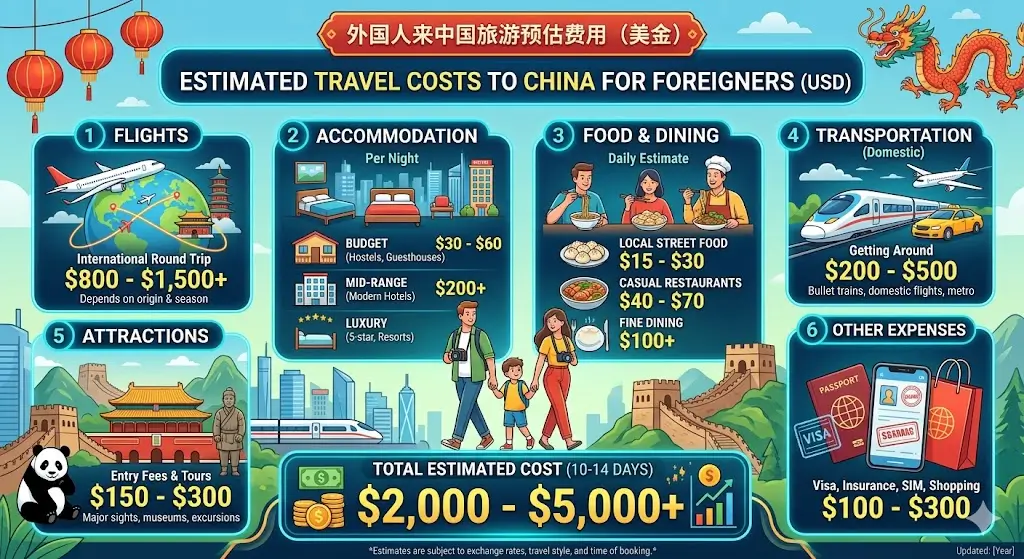
This China travel cost guide for foreign travelers is the most up-to-date, no-fluff breakdown for 2026, with real, on-the-ground numbers from my own travels, plus insights from hundreds of foreign travelers I’ve helped plan their China trips. We’re covering every single thing: 1-week, 15-day, and 30-day itineraries across China’s most popular regions, exact daily costs for accommodation, food, transport, attractions, and even hidden fees you’ve probably never thought of. Plus, I’m throwing in game-changing China Travel Tips, answers to your biggest question: is it safe to travel to china right now, and so much more to make your travel to china seamless and stress-free.
Before we dive in: all numbers below are in USD (with RMB equivalents in brackets), based on the 2026 exchange rate of 1 USD = 7.2 RMB. I’ve split every budget into 3 tiers: Budget (backpacker/hostel), Mid-Range (3-4 star hotel, private tours), and Luxury (5-star resorts, private transfers, fine dining) so you can pick exactly what fits your travel style. I’ve also broken down costs by China’s core travel regions, so you can see exactly how prices vary across provinces, and plan your itinerary to match your budget.china travel news
Understanding China’s Travel Regions: Cost Differences Across Provinces
China is a massive country—roughly the same size as the United States—so travel costs vary dramatically from province to province. A week in Shanghai will cost significantly more than a week exploring Yunnan’s ancient towns, and a luxury trip to Hainan’s beach resorts will have a very different price tag than a backpacking trip through Guizhou’s mountain villages. Below, I’ve broken down China’s most popular travel regions for foreign visitors, with key cultural highlights, can’t-miss attractions, and a detailed daily cost breakdown for every budget tier.
North China (Beijing & Hebei): Imperial History & Iconic Landmarks
No first trip to China is complete without a stop in Beijing, the nation’s capital and home to 5 UNESCO World Heritage Sites, including the Forbidden City, the Great Wall of China, and the Temple of Heaven. Hebei province, just a 1-2 hour drive from Beijing, is where you’ll find the most well-preserved sections of the Great Wall (Mutianyu and Jinshanling), plus the historic Chengde Mountain Resort. This region is perfect for travelers obsessed with Chinese imperial history, ancient architecture, and once-in-a-lifetime bucket-list landmarks.
Daily Cost Breakdown for Beijing & Hebei (Per Person):
- Budget Tier ($25-$35 / 180-252 RMB per day)
- Accommodation: $10-$15 (72-108 RMB) – Dorm bed in a clean, foreigner-friendly hostel in central Beijing (most include free breakfast and common areas)
- Food: $8-$10 (58-72 RMB) – Street food (jianbing, roujiamo), local noodle shops, and budget restaurants; a full meal at a local family-run spot costs just $3-$4
- Transport: $3-$5 (22-36 RMB) – Beijing subway is incredibly affordable (single ride $0.40/3 RMB), plus shared buses to the Great Wall for $5 round-trip
- Attractions: $4-$5 (29-36 RMB) – Most major sites have low entry fees: Forbidden City $8 (58 RMB), Mutianyu Great Wall $7 (50 RMB); split across multiple days, this averages out perfectly
- Mid-Range Tier ($70-$110 / 504-792 RMB per day)
- Accommodation: $35-$60 (252-432 RMB) – 3-4 star hotel in central Beijing (Wangfujing or Dongcheng district), with private room, ensuite bathroom, and daily breakfast
- Food: $20-$30 (144-216 RMB) – Mix of local restaurants, casual international spots, and a few special meals (like authentic Peking duck, which costs $15-$25 per person for a full set)
- Transport: $10-$15 (72-108 RMB) – Private taxi rides within the city, plus a private round-trip transfer to the Great Wall (avoiding crowded public buses)
- Attractions: $5-$10 (36-72 RMB) – Entry fees to all major sites, plus optional add-ons like audio guides, cable car rides on the Great Wall, and small-group guided tours
- Luxury Tier ($220-$350+ / 1584-2520+ RMB per day)
- Accommodation: $150-$250 (1080-1800 RMB) – 5-star international hotel or boutique luxury property in central Beijing, with premium amenities, concierge service, and views of iconic landmarks
- Food: $50-$80 (360-576 RMB) – Fine dining experiences, Michelin-recommended Peking duck restaurants, private dining rooms, and premium international cuisine
- Transport: $20-$40 (144-288 RMB) – Private car and driver for the entire day, including transfers to and from the Great Wall and all city attractions
- Attractions: $10-$20 (72-144 RMB) – VIP guided tours of the Forbidden City and Great Wall, after-hours access to select sites, and exclusive cultural experiences (like calligraphy classes with local masters)
East China (Shanghai, Jiangsu, Zhejiang): Modern Metropolises & Water Town Charm
East China is the perfect blend of China’s ultra-modern present and its ancient, poetic past. Shanghai, China’s largest city, is a global financial hub with iconic skyscrapers (the Oriental Pearl Tower, Shanghai Tower), the historic Bund, and a vibrant international food and arts scene. Jiangsu province is home to Suzhou’s classical gardens (UNESCO World Heritage Sites) and the ancient water town of Zhouzhuang, while Zhejiang province boasts Hangzhou’s stunning West Lake, the tea plantations of Longjing, and the water town of Wuzhen. This region is perfect for travelers who want to experience both China’s modern dynamism and its traditional Jiangnan water town culture.
Daily Cost Breakdown for East China (Per Person):
- Budget Tier ($22-$32 / 158-230 RMB per day)
- Accommodation: $9-$14 (65-101 RMB) – Hostel dorm beds in central Shanghai, Suzhou, or Hangzhou, with social common areas and free breakfast
- Food: $7-$9 (50-65 RMB) – Local xiaolongbao (soup dumplings), noodle shops, and street food; a full meal of xiaolongbao costs $2-$3
- Transport: $3-$5 (22-36 RMB) – Shanghai metro, public buses, and high-speed trains between cities (Shanghai to Suzhou is just $3 one-way)
- Attractions: $3-$4 (22-29 RMB) – Most gardens and water towns have entry fees between $4-$10, split across multiple days; West Lake is completely free to visit!
- Mid-Range Tier ($65-$100 / 468-720 RMB per day)
- Accommodation: $32-$55 (230-396 RMB) – 3-4 star hotel in central Shanghai, or boutique water town guesthouse in Suzhou/Hangzhou
- Food: $18-$28 (130-202 RMB) – Shanghainese cuisine restaurants, international cafes, and specialty tea house experiences
- Transport: $10-$15 (72-108 RMB) – Taxi rides, private transfers to water towns, and high-speed train tickets between cities
- Attractions: $5-$10 (36-72 RMB) – Entry fees, guided tours of the classical gardens, Huangpu River cruises, and tea tasting experiences
- Luxury Tier ($200-$320+ / 1440-2304+ RMB per day)
- Accommodation: $130-$220 (936-1584 RMB) – 5-star luxury hotel on the Bund in Shanghai, or exclusive boutique resort in Hangzhou’s West Lake area
- Food: $45-$75 (324-540 RMB) – Michelin-recommended Shanghainese cuisine, private dining rooms, and high-end international restaurants
- Transport: $25-$45 (180-324 RMB) – Private car and driver, business class high-speed train tickets, and private Huangpu River yacht cruises
- Attractions: $15-$20 (108-144 RMB) – VIP private tours of the gardens, exclusive tea ceremonies with master tea makers, and after-hours access to historic sites
Southwest China (Sichuan, Chongqing, Yunnan): Stunning Nature, Spicy Food & Ethnic Culture
The southwest is my absolute favorite region of China, and it’s a must-visit for any traveler who loves jaw-dropping natural scenery, world-famous food, and rich ethnic minority culture. Sichuan province is home to Chengdu (the capital of Sichuan hotpot and giant pandas), Jiuzhaigou Valley’s crystal-clear lakes, and the sacred Mount Emei. Chongqing, China’s mountain municipality, is famous for its neon-lit Hongyadong stilt houses, spicy hotpot, and Yangtze River cruises. Yunnan province, in the far southwest, is a backpacker’s paradise, with Lijiang Ancient Town, Dali’s Erhai Lake, Shangri-La’s Tibetan culture, and the stone forests of Kunming. What makes this region even better? It’s significantly more affordable than Beijing and Shanghai, especially for accommodation and food, making it perfect for budget and mid-range travelers.
Daily Cost Breakdown for Southwest China (Per Person):
- Budget Tier ($20-$30 / 144-216 RMB per day)
- Accommodation: $8-$12 (58-86 RMB) – Hostel dorm beds in Chengdu, Chongqing, or Dali, many with rooftop terraces and free breakfast
- Food: $6-$8 (43-58 RMB) – Street food, local noodle shops, and family-run restaurants; a full bowl of spicy Chongqing noodles costs just $1.50, and a shared hotpot meal is $3-$4 per person
- Transport: $2-$4 (14-29 RMB) – Public buses, metro, and shared rides between towns; long-distance buses between cities in Yunnan cost $10-$20 one-way
- Attractions: $4-$6 (29-43 RMB) – Most natural sites have entry fees between $5-$15, split across multiple days; the Chengdu Panda Base entry fee is $8 (58 RMB)
- Mid-Range Tier ($60-$90 / 432-648 RMB per day)
- Accommodation: $30-$50 (216-360 RMB) – 3-4 star boutique hotels or private guesthouses, many with traditional courtyard designs in ancient towns
- Food: $15-$25 (108-180 RMB) – Mix of local hotpot restaurants, casual cafes, and specialty Sichuan/Yunnan cuisine meals
- Transport: $8-$12 (58-86 RMB) – Private taxi rides, high-speed train tickets between major cities, and private transfers to natural attractions
- Attractions: $7-$10 (50-72 RMB) – Entry fees, cable car rides, private guided tours of the Panda Base and ancient towns, and cultural experiences like ethnic minority dance shows
- Luxury Tier ($180-$300+ / 1296-2160+ RMB per day)
- Accommodation: $120-$200 (864-1440 RMB) – 5-star resorts, luxury boutique hotels, and private villas with lake or mountain views
- Food: $40-$70 (288-504 RMB) – Fine dining Sichuan cuisine, private hotpot rooms, and farm-to-table Yunnan ethnic cuisine experiences
- Transport: $20-$40 (144-288 RMB) – Private car and driver for daily excursions, business class high-speed train tickets, and domestic flights between remote destinations
- Attractions: $15-$20 (108-144 RMB) – VIP access to the Panda Base, private trekking tours in Jiuzhaigou, exclusive ethnic minority home visits, and cultural workshops
Northwest China (Shaanxi, Gansu): Silk Road History & Epic Landscapes
For travelers obsessed with ancient history and epic, wide-open landscapes, Northwest China is an absolute dream. Shaanxi province’s capital, Xi’an, is the starting point of the ancient Silk Road, home to the world-famous Terracotta Army, the 600-year-old Xi’an City Wall, and a vibrant Muslim Quarter with some of China’s best street food. Further west, Gansu province is home to Dunhuang’s Mogao Grottoes (UNESCO World Heritage Site with 1,000+ years of Buddhist art), the rainbow mountains of Zhangye Danxia, and the historic Jiayuguan Pass, the western end of the Great Wall. This region is slightly more remote, so transport costs are a bit higher, but accommodation and food are still extremely affordable.
1-Week China Travel Itinerary & Total Budget Breakdown for Foreign Travelers
If you’ve only got 7 days in China, you want to hit the most iconic, unmissable spots without rushing through every province. My go-to 1-week itinerary for first-time foreign travelers is the Imperial & Ancient Capital Route: Beijing (4 days) + Xi’an, Shaanxi (3 days). This route lets you check off the two most important historical cities in China, with bucket-list landmarks, deep cultural immersion, and manageable travel times between destinations (2-hour direct flight between Beijing and Xi’an).
Itinerary Highlights
- Beijing: Forbidden City, Mutianyu Great Wall, Temple of Heaven, Summer Palace, Peking duck dinner, hutong walking tour
- Xi’an: Terracotta Army, Xi’an City Wall bike ride, Muslim Quarter food tour, Big Wild Goose Pagoda, Tang Dynasty cultural show
Total 7-Day Budget Breakdown (Per Person, Including Inter-City Transport)
Budget Tier: $280-$400 Total (2016-2880 RMB)
- Accommodation: $70-$105 (7 nights x $10-$15)
- Food: $56-$70 (7 nights x $8-$10)
- Local Transport: $21-$35 (7 nights x $3-$5)
- Inter-City Transport: $80-$120 (round-trip flight between Beijing and Xi’an, budget airlines like Spring Airlines have incredible deals if booked 2+ months in advance)
- Attractions & Experiences: $53-$70 (includes entry to all major sites, audio guides, and a local food tour)
This budget is perfect for backpackers and solo travelers who want to experience the best of China on a tight budget, staying in social hostels, eating like a local, and using public transport.
Mid-Range Tier: $750-$1150 Total (5400-8280 RMB)
- Accommodation: $245-$420 (7 nights x $35-$60)
- Food: $140-$210 (7 nights x $20-$30)
- Local Transport: $70-$105 (7 nights x $10-$15)
- Inter-City Transport: $150-$220 (direct round-trip flight, full-service airline with checked baggage)
- Attractions & Experiences: $145-$195 (includes all entry fees, private guided tours of the Forbidden City and Terracotta Army, cable car rides, and a Tang Dynasty dinner show)
This is the most popular tier for foreign travelers, offering comfort, convenience, and immersive cultural experiences without breaking the bank.
Luxury Tier: $2200-$3800+ Total (15840-27360+ RMB)
- Accommodation: $1050-$1750 (7 nights x $150-$250)
- Food: $350-$560 (7 nights x $50-$80)
- Local Transport: $140-$280 (7 nights x $20-$40)
- Inter-City Transport: $300-$500 (business class round-trip flight, or private high-speed train first class)
- Attractions & Experiences: $360-$710 (VIP after-hours tours, private cultural workshops, exclusive access to heritage sites, and private drivers for every day of your trip)
This tier is for travelers who want a seamless, premium China travel experience, with personalized service and once-in-a-lifetime cultural access.
15-Day China Travel Itinerary & Total Budget Breakdown for Foreign Travelers
With 15 days in China, you can expand your trip to cover 4 of China’s core travel regions, getting a taste of both the north, west, southwest, and east of the country. My recommended 15-day itinerary for foreign travelers is: Beijing (4 days) → Xi’an (3 days) → Chengdu & Chongqing (3 days) → Shanghai + Suzhou & Hangzhou (5 days). This route covers imperial history, Silk Road culture, spicy Sichuan food, giant pandas, modern Shanghai, and ancient water towns—giving you a full, well-rounded experience of China without feeling rushed.
Total 15-Day Budget Breakdown (Per Person, Including Inter-City Transport)
Budget Tier: $750-$1050 Total (5400-7560 RMB)
- Accommodation: $150-$225 (15 nights x $10-$15)
- Food: $105-$150 (15 nights x $7-$10)
- Local Transport: $45-$75 (15 nights x $3-$5)
- Inter-City Transport: $300-$400 (domestic flights and high-speed train tickets between all destinations, booked in advance)
- Attractions & Experiences: $150-$200 (entry to all major sites, audio guides, and local food tours)
Mid-Range Tier: $1800-$2700 Total (12960-19440 RMB)
- Accommodation: $525-$825 (15 nights x $35-$55)
- Food: $300-$450 (15 nights x $20-$30)
- Local Transport: $150-$225 (15 nights x $10-$15)
- Inter-City Transport: $450-$600 (full-service flights and high-speed train 2nd class tickets between destinations)
- Attractions & Experiences: $375-$600 (private guided tours, cable car rides, cultural experiences, and special meals)
Luxury Tier: $5500-$9000+ Total (39600-64800+ RMB)
- Accommodation: $2250-$3750 (15 nights x $150-$250)
- Food: $750-$1200 (15 nights x $50-$80)
- Local Transport: $300-$600 (15 nights x $20-$40)
- Inter-City Transport: $1200-$1800 (business class flights and high-speed train first class tickets between all destinations)
- Attractions & Experiences: $1000-$1650 (VIP tours, exclusive cultural experiences, private drivers, and luxury activities)
30-Day China Cross-Country Travel Itinerary & Total Budget Breakdown for Foreign Travelers
With 30 days in China, you can embark on a true cross-country adventure, exploring every corner of the country and diving deep into China’s diverse regional cultures, landscapes, and cuisines. My ultimate 30-day itinerary for foreign travelers covers 8 provinces and 5 core regions: Beijing (4 days) → Xi’an (3 days) → Dunhuang & Zhangye (3 days) → Chengdu (4 days) → Lijiang & Dali (5 days) → Guilin & Yangshuo (3 days) → Guangzhou (2 days) → Shanghai + Hangzhou (6 days). This itinerary lets you experience everything from the Great Wall to the Silk Road, from Tibetan villages to tropical karst mountains, and from ancient capitals to modern metropolises.
Total 30-Day Budget Breakdown (Per Person, Including Inter-City Transport)
Budget Tier: $1800-$2600 Total (12960-18720 RMB)
- Accommodation: $300-$450 (30 nights x $10-$15)
- Food: $210-$300 (30 nights x $7-$10)
- Local Transport: $90-$150 (30 nights x $3-$5)
- Inter-City Transport: $800-$1100 (domestic flights, long-distance buses, and high-speed train tickets across the country, booked 2+ months in advance)
- Attractions & Experiences: $400-$600 (entry to all major sites, trekking permits, and local cultural experiences)
This is the ultimate backpacker’s itinerary, perfect for travelers who want to spend a full month exploring China on a budget, meeting other travelers, and living like a local.
Mid-Range Tier: $4200-$6300 Total (30240-45360 RMB)
- Accommodation: $1050-$1650 (30 nights x $35-$55)
- Food: $600-$900 (30 nights x $20-$30)
- Local Transport: $300-$450 (30 nights x $10-$15)
- Inter-City Transport: $1200-$1800 (full-service domestic flights and high-speed train 2nd class tickets across the country)
- Attractions & Experiences: $1050-$1500 (private guided tours, multi-day treks, cultural workshops, and special dining experiences)
This is the most popular 30-day tier for foreign travelers, offering comfort and flexibility to explore remote regions without sacrificing immersive cultural experiences.
Luxury Tier: $12000-$20000+ Total (86400-144000+ RMB)
- Accommodation: $4500-$7500 (30 nights x $150-$250)
- Food: $1500-$2400 (30 nights x $50-$80)
- Local Transport: $600-$1200 (30 nights x $20-$40)
- Inter-City Transport: $3000-$4500 (business class domestic flights and private high-speed train cabins across the country)
- Attractions & Experiences: $2400-$4400 (VIP exclusive access, private multi-day tours, luxury cruises, and once-in-a-lifetime cultural experiences)
Essential China Travel Tips for Foreign Travelers
Before you book your trip, here are my top game-changing China Travel Tips to save you money, avoid stress, and make the most of your time in China:
- Book transport in advance: High-speed train tickets and domestic flights sell out fast, especially during peak travel seasons. Book 2+ months in advance for the best prices, and use the official Ctrip international app for easy booking in English.
- Get a local SIM card or eSIM: China’s internet has restrictions on many foreign apps, so a local SIM card with a VPN is essential. You can pick up a SIM card at the airport when you arrive, or buy an eSIM online before your trip for just $10-$15 for 2 weeks of data.
- Carry cash: While major cities accept international credit cards at big hotels and restaurants, most small shops, street food vendors, and local attractions only accept cash or Chinese mobile payment apps. I recommend carrying $100-$150 worth of RMB cash at all times.
- Avoid peak travel seasons: The most expensive times to travel to China are during Chinese New Year (January-February), National Day Holiday (October 1-7), and Labor Day Holiday (May 1-5). Travel during the off-season (March-April, September-November) for lower hotel prices, fewer crowds, and better weather.
One of the most common questions I get from foreign readers is: is it safe to travel to china right now? The short answer is YES. China is consistently ranked as one of the safest countries in the world for foreign travelers, with extremely low rates of violent crime, especially against tourists. Major cities have 24/7 police presence, well-lit public areas, and reliable public transport that’s safe to use even late at night. As with any international travel, you should take basic precautions: keep your valuables secure in crowded tourist areas, use licensed taxis or ride-hailing apps, and follow the latest china travel advisory from your home country’s embassy. For the most up-to-date entry requirements, safety updates, and china travel news, I always recommend checking the official China Travel Guide from the Ministry of Culture and Tourism of the People’s Republic of China , which is the most authoritative source for foreign travelers. For more destination-specific advice, you can also visit the trusted Travel China Guide website, which has detailed guides for every province in China.
For more tips on navigating mobile payment in China as a foreign traveler, check out our step-by-step guide here. If you’re planning a trip to Yunnan, don’t miss our in-depth 10-day Yunnan travel itinerary for backpackers, and for food lovers, our ultimate guide to Sichuan hotpot for first-timers has everything you need to know.
FAQ: About Travel to China for Foreigners
FAQ 1: What is the average daily cost of travel to China for a foreign traveler?
The average daily cost of travel to China varies dramatically based on your travel style and the provinces you visit. For a budget backpacker, the average daily cost is $20-$35 per person, including accommodation, food, transport, and attractions. For a mid-range traveler, the average daily cost is $60-$110 per person, and for a luxury traveler, the average daily cost starts at $180 per person and can go up to $350+ per person in major cities like Beijing and Shanghai. The most affordable provinces to visit are Yunnan, Guizhou, and Gansu, while the most expensive are Shanghai, Beijing, and Hainan (during peak season).
FAQ 2: Do I need a visa to travel to China, and how much does it cost?
Most foreign travelers need a tourist visa (L Visa) to enter mainland China. The cost of a Chinese tourist visa varies by your home country: for US citizens, it costs $140 for a single-entry, double-entry, or 10-year multiple-entry visa. For citizens of the UK, Canada, Australia, and most European countries, the cost ranges from $30-$90 for a single-entry visa. There are also visa-free transit options for many nationalities: you can stay in China for 144 hours (6 days) visa-free if you’re transiting through major cities like Beijing, Shanghai, Guangzhou, and Chengdu, as long as you have a confirmed onward flight to a third country. Always check the latest visa requirements with the Chinese embassy in your home country before booking your trip.
FAQ 3: What is the cheapest time of year to travel to China?
The cheapest time to travel to China is during the off-season, which is late November to early March (excluding Chinese New Year). During this time, hotel prices drop by 30%-50% in most tourist destinations, domestic flights have huge discounts, and there are almost no crowds at major attractions. The weather is cold in northern China, but southern China (Yunnan, Guangxi, Guangdong) has mild, pleasant weather during the winter months. The shoulder seasons (March-April and September-November) have slightly higher prices than the off-season, but offer the best weather across most of China, making them a great balance of value and comfort.
FAQ 4: Can I use my international credit card in China, or do I need cash?
International credit cards (Visa, Mastercard, American Express) are accepted at major international hotels, high-end restaurants, and large shopping malls in big cities like Beijing, Shanghai, and Guangzhou. However, most small businesses, street food vendors, local restaurants, public transport, and smaller tourist attractions do not accept international credit cards. Cash is still widely used across China, especially in smaller cities and rural areas, so I recommend exchanging some RMB before your trip, or withdrawing cash from an ATM at the airport when you arrive. For added convenience, you can also set up Alipay’s international version, which allows foreign travelers to link their international credit cards and make mobile payments across China.
Travel Wishes for Your China Adventure
To every traveler reading this, whether you’re planning a 7-day bucket-list trip or a 30-day cross-country adventure across China: I hope this China travel cost guide for foreign travelers has taken the stress out of planning, and filled you with excitement for the journey ahead. China is a country that will surprise you, move you, and stay with you long after you leave. It’s in the warm smile of a street food vendor handing you a fresh jianbing on a cold morning, the quiet awe of standing on the Great Wall and looking out at the mountains that have watched over this land for thousands of years, the laughter of sharing a steaming hotpot meal with new friends, and the magic of getting lost in an ancient water town where time seems to stand still.
No matter your budget, your travel style, or which provinces you choose to explore, I wish you a journey filled with endless wonder, delicious food, safe travels, and unforgettable memories. May every step you take in China bring you new joy, new understanding, and a deep love for this incredible country and its people. Welcome to China—we can’t wait to see you here.

 Chinese
  English