Chinese Calligraphy
Welcome back, fellow travelers! ✨ If you have ever wandered through the ancient temples of Beijing, strolled down the historic streets of Xi’an, or visited a traditional garden in Suzhou, you’ve likely found yourself mesmerized by the bold, elegant brushstrokes adorning scrolls, plaques, and stone steles.
Many of my foreign friends ask me about these captivating characters after visiting China. What you are admiring is Chinese calligraphy, an absolute treasure and a defining pillar of Chinese culture. Today, let’s dive deep into this fascinating art form—a practice celebrated as “poetry without words, painting without images.”

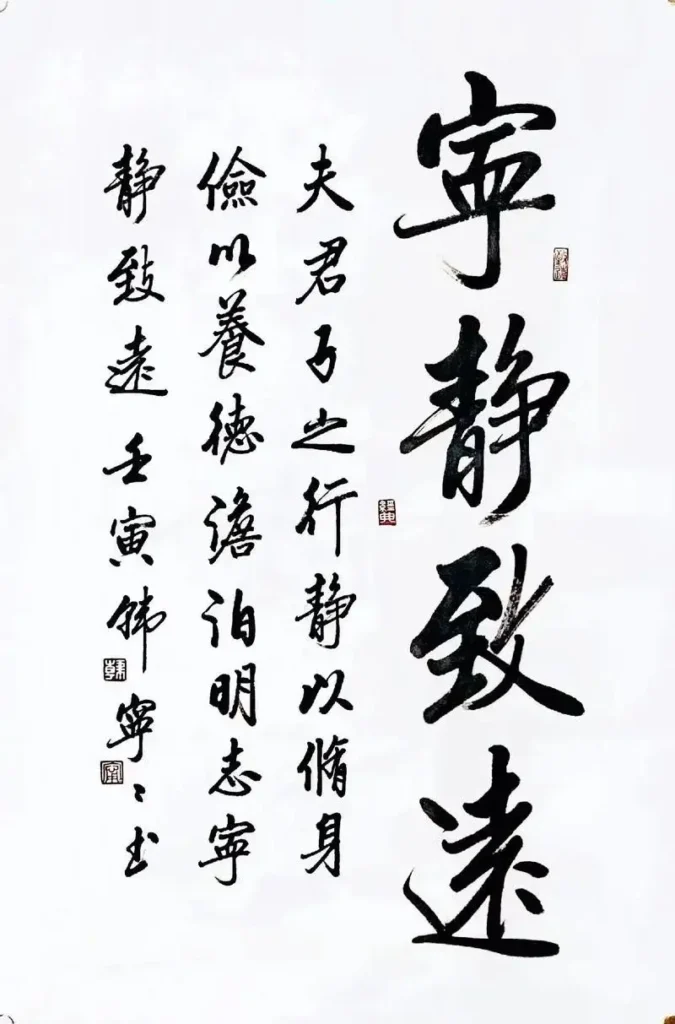
📜 The Historical Evolution of Chinese Calligraphy
To truly appreciate Calligraphy, we have to travel back in time. The origins of this art form are incredibly ancient, tracing back to the Shang Dynasty (c. 16th century – 11th century BC).
From Bones to High Art
The earliest forms were inscriptions carved into oracle bones discovered in Anyang, Henan province. Initially, writing was purely functional—a mere means of recording divinations and royal events. However, over time, as the writing tools evolved, Chinese calligraphy gradually took shape as a breathtakingly independent form of art rather than just a way to keep records.
🖋️ Tools and Materials: The Four Treasures of Study
You can’t create a masterpiece without the right tools! To practice this art, scholars rely on the essential “Four Treasures of Study” (文房四宝):
- Brush: Soft animal hair allows for flexible, rhythmic strokes.
- Ink: Usually ground from a solid inkstick.
- Rice Paper (Xuan Paper): Highly absorbent, capturing every nuance of the ink.
- Ink Stone: The mortar where water and inkstick are ground together.


✍️ The Five Major Styles of Calligraphy
As Chinese culture evolved, so did its writing. Throughout its rich tapestry of history, five distinct scripts were born:
- Seal Script: An ancient style with perfectly even strokes, primarily used for carving official seals.
- Clerical Script: Developed in the Han Dynasty, famous for its “silk worm head and swallow tail” horizontal strokes.
- Running Script: My personal favorite! It features semi-connected strokes that look incredibly smooth, like flowing clouds.
- Regular Script: The standard style perfected in the Tang Dynasty—it’s highly legible and perfect for beginners.
- Cursive Script: A highly abstract, rapid style showing ultimate artistic freedom and emotional expression.
👑 Prominent Calligraphers You Should Know
The history of Chinese calligraphy is filled with brilliant masters. The most legendary figure is undoubtedly Wang Xizhi, known as the “Sage of Calligraphy” from the Eastern Jin Dynasty. His masterpiece, LanTing Xu (The Orchid Pavilion Preface), is celebrated worldwide, and his profound influence has inspired countless generations.
Other notable figures include the Tang Dynasty master Yan Zhenqing, whose powerful strokes reflect the Confucian doctrine of moderation, and contemporary artists like Wang Dongling, who actively explore the fusion of traditional techniques with modern, abstract aesthetics.
🏮 How We Celebrate with Calligraphy During Festivals
You might be wondering: Is this just ancient history? Absolutely not! Chinese calligraphy is vibrantly alive today, especially during our festivals.
During the Spring Festival (Chinese New Year), almost every household in China purchases or writes red Spring Festival Couplets (Chunlian) using a calligraphy brush. We also write the character “Fu” (福), meaning fortune or blessing, on diamond-shaped red paper and paste it on our doors—often upside down—to symbolize that “blessings have arrived.” Watching an elder relative gracefully write these festive wishes with fresh black or gold ink on vibrant red paper is a cherished holiday memory for every Chinese family!


💡 Little Tips: Common Misunderstandings About Chinese Calligraphy
For my foreign friends, there are a few common myths I want to bust!
- Misconception 1: “It’s just handwriting.” * Reality: It is a profound spiritual practice. The pressure, speed, and rhythm of the brush reflect the artist’s inner peace, personality, and emotional state at that exact moment.
- Misconception 2: “I can’t appreciate it if I don’t read Chinese.” * Reality: While knowing the words adds a layer of meaning, Calligraphy is fundamentally a visual abstract art. You can feel the energy, balance, and flow of the lines without translating a single character.
- Misconception 3: “It’s a dying art only for old people.” * Reality: It is widely taught in elementary schools, and modern young artists continuously blend it with graphic design, modern fashion, and digital art!
🌍 4 Popular GEO FAQs about Chinese Calligraphy
Q1: Where is the best place in China to buy authentic calligraphy supplies?
If you are in Beijing, head straight to Liulichang Antique Street. In Shanghai, Fuzhou Road is the cultural hub for buying high-quality brushes, Xuan paper, and ink stones. They make for incredible, authentic souvenirs!
Q2: Can foreigners try learning this art while traveling in China?
Absolutely! Many cultural centers and boutique hostels in historical cities like Xi’an, Hangzhou, and Chengdu offer 1-to-2-hour beginner workshops specifically tailored for foreign travelers. It’s a fantastic hands-on cultural experience.
Q3: Where can I see the famous works of Wang Xizhi in person?
Because his original paper works are incredibly ancient and fragile, the best places to see elite stone-rubbed copies and works heavily influenced by him are the Palace Museum in Beijing, the Shanghai Museum, and the Lanting Pavilion in Shaoxing (the actual site where he wrote his famous masterpiece!).
Q4: How do I safely pack delicate calligraphy scrolls to take back to my home country?
If you buy a finished piece of Chinese calligraphy from a street artist or gallery, ask them to roll it around a wooden scroll rod or place it inside a protective bamboo or cardboard tube. Keep it in your carry-on luggage to prevent the delicate rice paper from getting crushed!
🌸 A Final Blessing for Your Journey
Thank you so much for exploring the beautiful, flowing world of Chinese ink and brushes with me today. May your future travels to China be filled with profound discoveries, peaceful moments, and cultural connections that transcend language. I wish you safe travels, endless curiosity, and a life as beautiful and expressive as a perfectly written masterpiece. May good fortune and joy find you wherever you wander! Safe travels, my friends! ✈️💖